




How to Start Tiny or Hard-to-Germinate Seeds with a 288-Cell Tray

Some seeds are frustrating to place one at a time. They may be extremely small, germinate unevenly, or be better started densely and selected later.
For those crops, a 288-cell tray can be used as a high-density starter tray rather than the final transplant container.
The Broadcast and Pop idea

The Winstrip 288 Broadcast and Pop method is simple:
- Fill and dibble a Winstrip 288 tray.
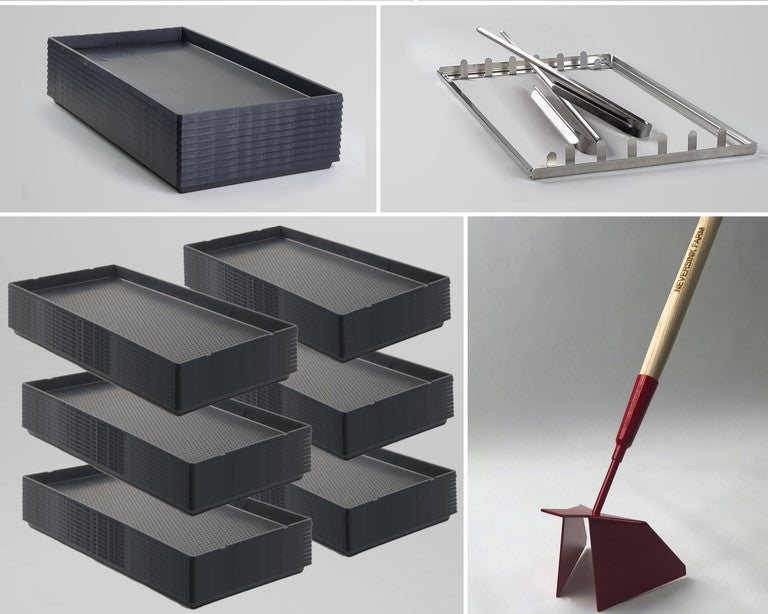
- Use the Broadcast Seeding Cover to help center broadcast seed over the cells.
- Germinate the seedlings in the 288.
- Once the seedlings are ready, pop the starts out.
- Pot them on into a larger tray or container.
Why broadcast instead of placing every seed?
When seed is tiny, hand placement can be slower than the rest of the propagation process. Broadcasting allows you to sow quickly, while the seeding cover helps guide seed toward the cell openings.
This is especially useful when germination percentage is uncertain because the 288 provides a compact space to start a large number of seedlings before you decide which ones move on.
Why use a 288?
A 288-cell tray fits a very large number of starts into a standard tray footprint. That reduces the amount of bench, germination-chamber, and heated propagation space used during the earliest stage.
The tradeoff is cell volume. The 288 is not intended to hold every crop indefinitely. In the Broadcast and Pop workflow, density is an advantage because the seedlings will be moved into a larger cell after they establish.
Dibbling and popping with one tool

The Winstrip Dibble Board & Plug Popper is designed to match specific Winstrip tray layouts. One side speeds preparation of the filled tray; the popping function helps remove plugs uniformly when they are ready to move.
When this method makes the most sense
- Very small seed that is tedious to place individually.
- Seed with uneven or lower germination.
- Crops you would otherwise sow densely and prick out by hand.
- Propagation systems where heated or germination space is limited.
Think of the 288 as stage one
The key is not to treat every seedling tray as a final container. A dense 288 can be a highly efficient first stage, followed by a larger cell once the strongest seedlings are identified.
That approach keeps the most space-intensive part of propagation - the early germination stage - as compact as possible.
Related growing guides: choosing between seedling tray cell counts · when to use humidity domes.