




Air-Pruning Trays vs. Soil Blocks: Which Is Better for Seedlings?

Soil blocks and air-pruning trays are trying to solve the same basic problem: grow a dense, branched root system without letting roots circle inside a conventional plastic cell.
Both can do that well. The better choice depends on how you want to run your propagation house.
How soil blocks prune roots
A soil block has no surrounding plastic cell. When roots reach the outside edge of the block, they encounter air and stop extending. That makes soil blocks extremely effective at root pruning.
The tradeoff is that the growing media is also exposed on multiple sides, so blocks can lose moisture faster and require more attention to watering and handling.
How air-pruning trays work

Air-pruning trays keep the convenience and structure of a reusable tray while exposing specific portions of the plug to air. The goal is to interrupt root circling without exposing the entire root ball.
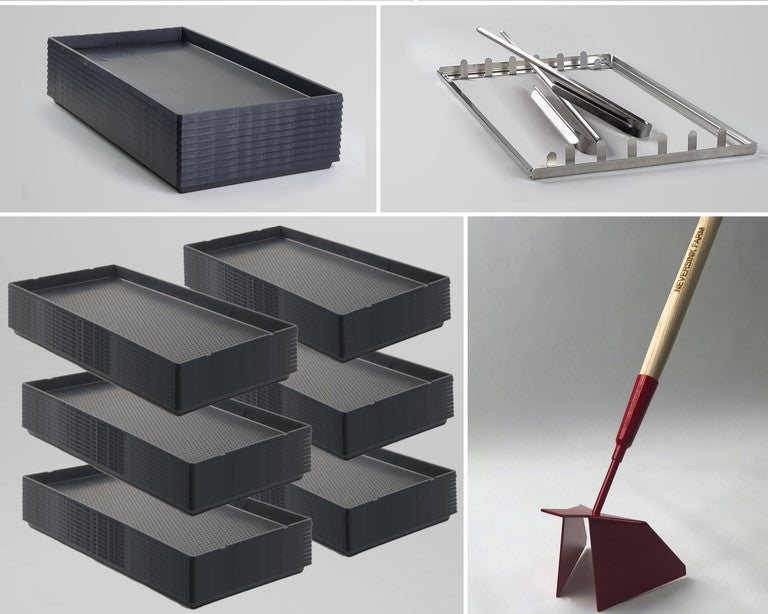
Winstrip® trays use an open-cell design that allows air to reach the lower and side areas where roots tend to concentrate.
Moisture management
Soil blocks have more exposed surface area and can dry quickly. That can be useful when managed carefully, but it also reduces the margin for error during busy periods.
Air-pruning trays generally retain more of the plug inside a cell while still creating root-tip exposure. For many growers, that is an easier balance between pruning and moisture retention.
Handling and workflow
Reusable trays are easy to move, stack, fill, seed, bottom-water, and transport as a unit. Soil blocks eliminate the cell itself but require a block-making step and more care when moving young blocks before roots knit them together.
Propagation density
Trays also make it easy to choose a repeatable production density. Winstrip formats range from larger 50-cell plugs to dense 288-cell starts, so growers can match cell volume to nursery time and crop size.
Which produces better roots?
Both systems can produce excellent roots when used correctly. In our own tests at Neversink Farm, soil blocks pruned very aggressively, but they also dried faster. Air-pruning trays gave us the root-pruning behavior we wanted with a workflow that was easier to standardize across a busy propagation house.
Choose the system that fits your farm
Use soil blocks if you value maximum exposed-surface pruning and are comfortable managing the extra moisture and handling sensitivity. Use air-pruning trays if you want repeatable cell sizes, durable equipment, easier movement, and strong root pruning in a tray-based workflow.
Many small farms can grow excellent transplants with either. The important thing is to avoid conventional cell designs that encourage roots to circle rather than branch.
Related growing guides: what is air pruning · choosing a seedling tray size.