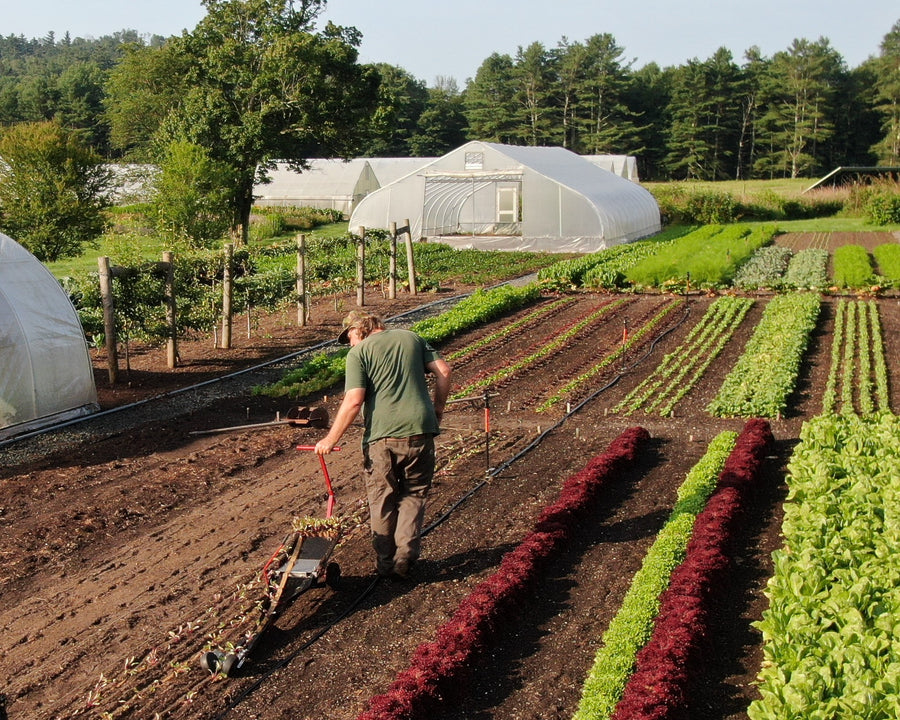





The Paperpot system has transformed how many growers cultivate their crops. By using biodegradable paper chains that transplant directly into the field, it cuts hours of labor and makes seeding fast, uniform, and efficient. They also help get crops into the ground quickly and easily in the shoulder seasons.
But not every crop is an ideal match for Paperpots. Below are some of the best crops to transplant with the system—plus tips to give them the right start.
Onions & Shallots
Onions are one of the standout Paperpot crops for transplanting both indoors and out in the field. The even spacing leads to a more uniform bulb size, and it’s much faster and more efficient than planting out in sets or hand-transplanting seedlings. Restaurants and market customers appreciate the consistent sizing too- keeping these crops in high demand.
-
Setup: 4" Paperpots, 3 rows per bed.
Red/Yellow Onions: 1 seed per cell.
Shallots: 3 seeds per cell.

Lettuce
Lettuce transplants are quick to put in, and uniform spacing means you can harvest predictably and cleanly. Whether you’re growing for market mix or full heads, Paperpots streamline the process. These lettuces are also great for winter markets and restaurant clients
Head Lettuce: Plant 8" apart with 4 rows/bed, or 12" apart with 3 rows for large, round heads.
Salanova: 8" spacing, 4 rows per bed. Excellent for cut-and-come-again mixes.
Baby Lettuce Mix: 2" Paperpots, 6–8 rows per bed. Great for quick, dense harvests.
💡 Pro Tip: Watch transplant depth. Too deep, and heads can rot; too shallow, and plugs may dry out. For planting that is too deep, use a broom to sweep off excess soil. If the planting is too shallow, use a tool like the Zipper to deepen.


Beets
Beets are another great crop for paperpots. The key here is timing—the best height for transplanting is once they have germinated and have formed their true leaves- around 2” tall. If you wait until they grow taller, the leaves can tangle with each other and you are more likely to distort the root.
Setup: 3 rows per bed, 6" apart.
Seeds: Pelleted seed recommended; 1 seed per cell is ideal
💡 Pro Tip: Plant deep enough to cover the root —too shallow and they’ll dry out.
Pole Beans
Paperpots are a great 'insurance' for pole beans. Growers know when you direct seed beans, animals love to eat them- allowing them to germinate in the paperpots before transplanting is a low cost way to reduce risk in the field.
Setup: 4" Paperpots, 1 seed per cell, 1 row per bed.
💡 Pro Tip: You can transplant 6–8" from the trellis— as the tendrils grow, they will find the trellis on their own.

Cilantro & Dill
When direct-seeded in the field, these herbs take an extremely long time to germinate in the ground. With Paperpots, you can raise sturdy seedlings in the prop house, then transplant them easily for quicker growth and fuller harvests.
Cilantro: Use 2" Paperpots, 3–4 rows per bed, 2–3 seeds/cell.
Dill: Use 2" Paperpots, up to 6 rows per bed, 2 seeds/cell. You’ll get nice, full, bunches ready for market.
Spinach
Spinach is a popular crop for many growers, and it works especially well with paperpots. The small size of the seeds and the uniformity of the paperpots make it easy to plant large quantities of spinach quickly and with minimal effort. Plus, Paperpots allow for consistent spacing that reduces overcrowding, helps prevent disease, and results in a more even harvest.
Setup: 2" Paperpots; use a drop seeder or sprinkle seeds by hand.
Final Thoughts
The Paperpot system isn’t for every crop, but for the right ones it saves countless hours, ensures uniform spacing, and helps reduce risk in the field. From fast greens like spinach and lettuce to longer-season crops like onions and pole beans, Paperpots can be a powerful tool for boosting efficiency and yields for any market farm.
DISCOVER THE SUBVERSIVE PAPERPOT TRANSPLANTER AND NEVERSINK TOOLS PAPERPOT SYSTEM